
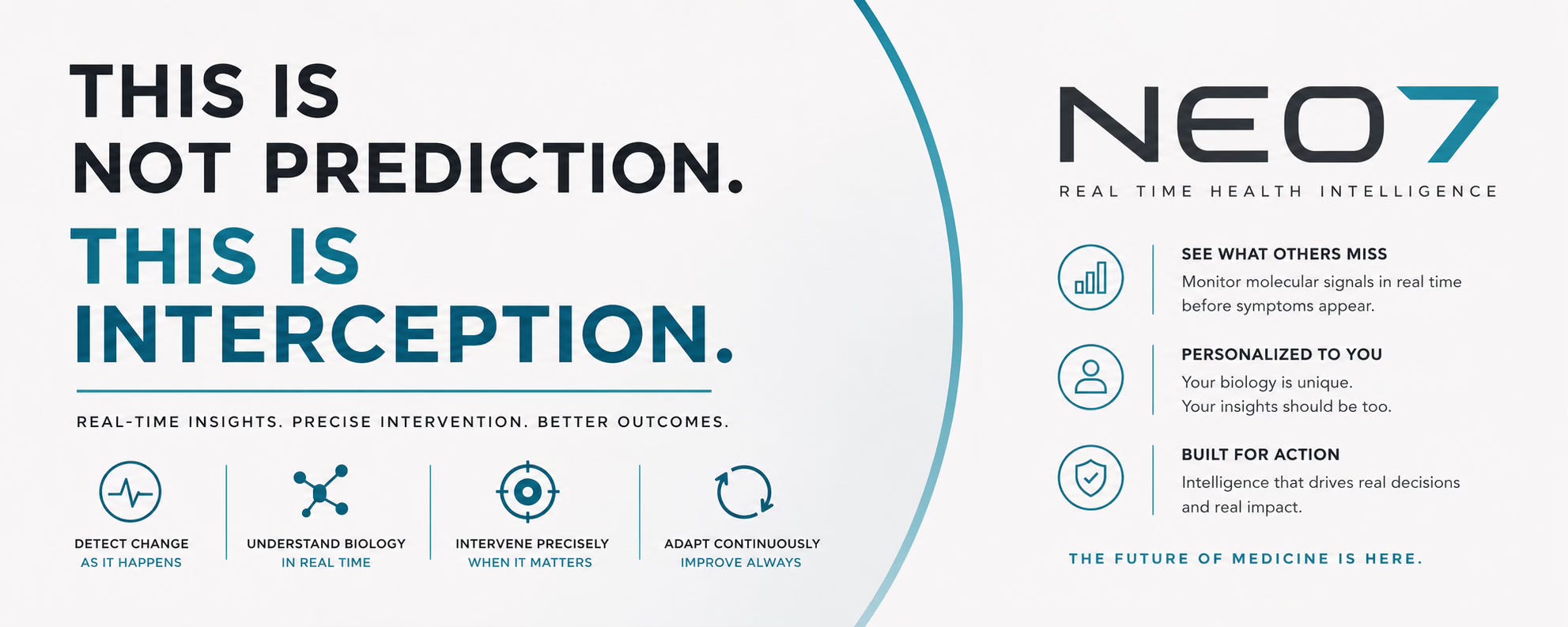
This is not prediction. This is interception.
Modern medicine is built on a delay.

Not because it lacks intelligence—
but because it was designed around what could be measured at the time.
Symptoms.
Lab markers.
Imaging results.
All of them share the same limitation:
They appear after the biological shift has already occurred.
By the time something is detectable,
the system is no longer observing change—
it is documenting consequence.
A tumor isn’t the beginning of disease.
It’s the result of processes that have been unfolding silently.
Chronic conditions don’t start at diagnosis.
They are the endpoint of continuous, unobserved disruption.
To compensate for this delay, medicine introduced prediction.
Risk scores.
Genetic probabilities.
Population-based models.
An attempt to move earlier on the timeline.
But prediction does not eliminate delay—
it reframes it.
It replaces “this has happened” with
“this might happen.”
And that distinction matters.
Because prediction is still built on:
Historical datasets
Statistical likelihoods
Generalized populations
It does not account for the real-time state of an individual system.
It cannot tell you what is happening right now inside a body.
It can only infer based on what has happened in others.
This is where the model breaks.
Because the human body is not static.
It is not average.
And it is not predictable in the way medicine has tried to define it.
It is dynamic.
Constantly adapting.
Continuously signaling.
Always changing at a molecular level long before symptoms appear.
Neo7 is built for that reality.
Not as an extension of the current system—
but as a replacement for its core limitation.
Instead of waiting for symptoms…
Neo7 observes molecular activity in motion.
Instead of relying on delayed markers…
Neo7 captures biological signals as they emerge.
Instead of estimating risk…
Neo7 identifies active shifts as they happen.
This is the difference:
Prediction asks:
“What are the chances something goes wrong?”
Interception answers:
“What is beginning to go wrong—right now?”
And that shift changes everything.
Because when you can see change at the moment it begins,
you are no longer managing disease—
you are managing trajectory.
Interception operates on a completely different timeline:
Not late-stage reaction.
Not future-based estimation.
But real-time awareness.
A continuous understanding of:
Cellular signaling
Molecular disruption
System-level imbalance
Before those changes accumulate into diagnosable disease.
This is what enables true precision.
Not precision based on matching a treatment to a diagnosis—
but precision based on aligning intervention
with the exact state of a living system in real time.
It transforms intervention from:
Delayed → Immediate
Generalized → Individualized
Reactive → Continuous
This is where Neo7 becomes more than a tool.
It becomes the central hub of a new medical framework.
A system that doesn’t just provide answers—
but evaluates every input, every intervention, every response
as it happens.
Medications.
Supplements.
Protocols.
Instead of asking “does this work in general?”
Neo7 asks:
“Is this working in this body, right now?”
That is the missing layer in modern healthcare.
A true feedback loop.
Because without feedback, every intervention is a guess—
no matter how advanced it appears.
Neo7 eliminates that guesswork.
By creating a continuous loop of:
Observe → Interpret → Adjust → Repeat
Not once.
Not periodically.
But continuously.
This is how medicine evolves from episodic care
to dynamic system management.
From isolated decisions
to integrated intelligence.
And most importantly—
from damage control
to prevention at the point of origin.
Because disease is not an event.
It is a process.
A progression of small, compounding changes
that go unnoticed until they can no longer be ignored.
Interception stops that progression.
Not by predicting the endpoint—
but by interrupting the process.
This is not about diagnosing earlier.
It is about eliminating the need for diagnosis as the primary entry point.
This is not about improving prognosis.
It is about preventing the conditions that require one.
This is not prediction.
Prediction still accepts uncertainty.
It still accepts delay.
It still accepts that we are reacting to something
we do not fully see.
This is interception.
A system that sees the shift
as it begins.
A system that responds
as it unfolds.
A system that keeps the body aligned
before it falls out of balance.
Neo7 is not adding to the current model of medicine.
It is redefining its operating system.
A move from:
Static → Dynamic
Delayed → Continuous
Reactive → Interceptive
This is where healthcare stops chasing disease—
and starts maintaining health in real time.
This is not prediction.
This is interception.
This is Neo7.
—
Subscribe to follow the central hub redefining healthcare.
More information: