
Neo7 Personalized Peptides in Cancer
Neo7Bioscience and McCullough Foundation: A Precision Oncology Hub Strategy with Durable Objective Responses, Tissue Protection, and Long-Term Survival

Introduction
Cancer is not a uniform adversary, and it cannot be responsibly addressed with population-averaged or assumption-based therapies. From the outset, personalized molecular targeting is absolutely essential—not as an enhancement, but as the foundational requirement for establishing effective biological defense, regulatory balance, and durable disease control. Neo7 Personalized Peptides in Cancer represents a precision systems-medicine approach that replaces toxicity, empiricism, and irreversible biological risk with continuous molecular surveillance, intelligent target selection, and personalized peptide engineering—while delivering highly favorable objective response rates (ORR) associated with long-term survival. By integrating functional genomics, ctDNA exome surveillance, proteomic profiling, and HLA phenotyping at initiation, Neo7 defines each individual’s unique molecular terrain before therapeutic pressure is applied. This early personalization establishes a regulatory framework that aligns immune activation, tumor suppression, and tissue protection from the very beginning, preventing misdirected immune responses, unnecessary tissue injury, accelerated resistance, and long-term biological instability. Rather than reacting to damage after it occurs, Neo7 builds a precision-guided defense system that regulates cancer biology while preserving human physiology.
The Neo7 Molecular Control Hub
The 10 Core Focus Areas Driving Precision Cancer Control, Defense, and Regulation
1. Individual-Centric Molecular Control (The Hub Principle)
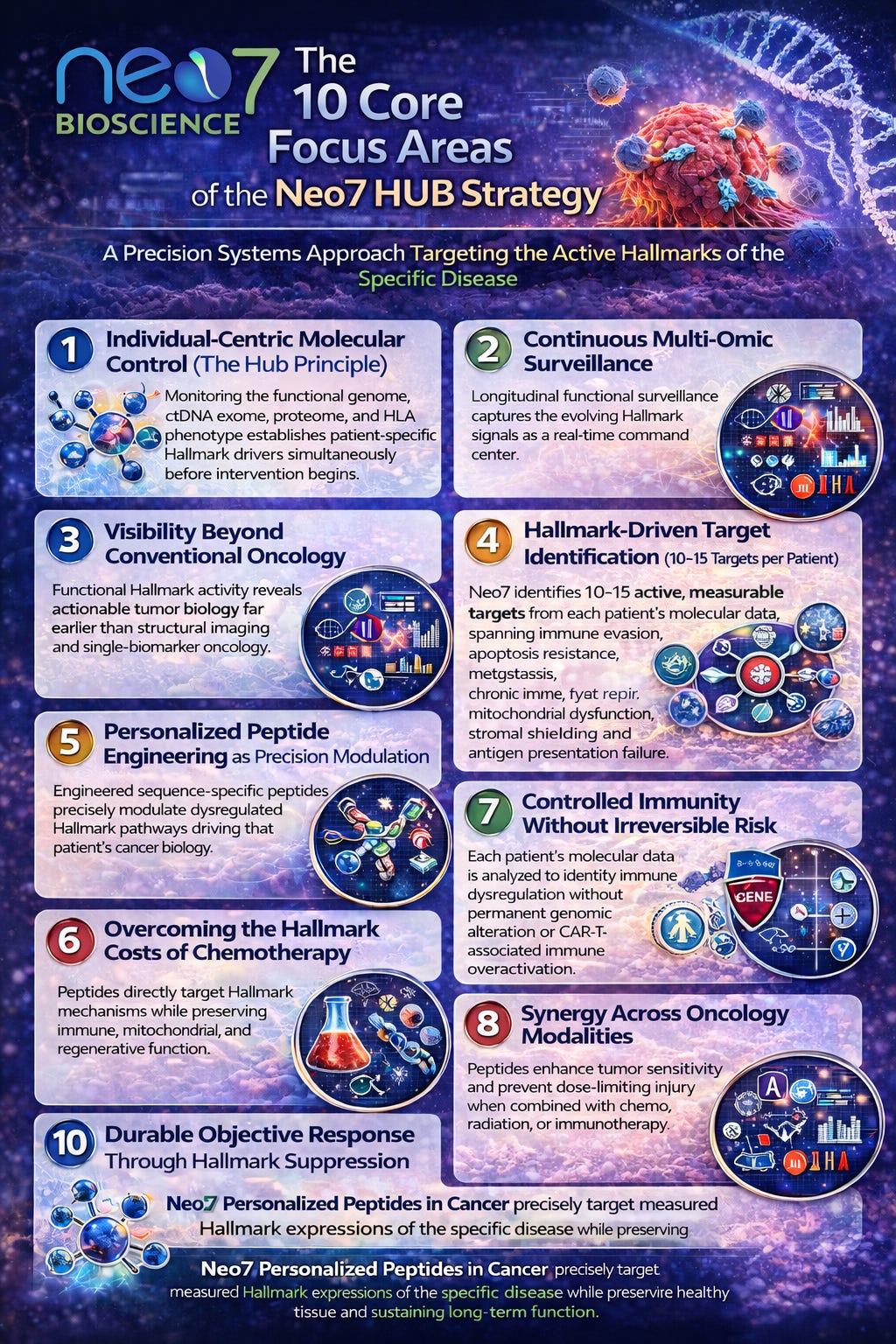
Neo7 operates as a molecular control hub, not a drug and not a fixed protocol. It is architected around the individual patient, using integrated, longitudinal surveillance to establish biological order from the outset. By anchoring therapy to the patient’s functional genome, ctDNA exome, proteome, and HLA phenotype, Neo7 defines the active Hallmark expressions of the specific disease before intervention begins. This ensures that immune defense, tumor suppression, and tissue regulation are aligned to the individual’s true cancer biology—not population averages.
2. Continuous Multi-Omic Surveillance
Cancer Hallmarks evolve over time; Neo7 continuously measures them. Through longitudinal multi-omic surveillance, Neo7 tracks dynamic Hallmark activity, including sustained proliferative signaling, immune evasion, metabolic reprogramming, and genomic instability. This surveillance functions as a real-time command center, allowing therapeutic decisions to remain synchronized with the disease’s changing molecular state rather than lagging behind it.
3. Visibility Beyond Conventional Oncology
Traditional oncology relies on static imaging and sparse biomarkers, capturing only late-stage structural change. Neo7 reveals functional Hallmark activity—including residual disease, immune exhaustion, inflammatory dominance, mitochondrial collapse, and tissue susceptibility—long before conventional methods detect failure. By identifying Hallmark activation early, Neo7 intervenes upstream of progression and resistance.
4. Hallmark-Driven Target Identification (10–15 Targets per Patient)
Neo7 does not target cancer broadly—it targets the specific Hallmarks driving that patient’s disease. From each individual’s molecular data, Neo7 identifies 10–15 actionable targets spanning immune evasion, apoptosis resistance, metastasis, angiogenesis, chronic inflammation, DNA repair imbalance, mitochondrial dysfunction, stromal shielding, and antigen presentation failure. Each target corresponds to measured Hallmark expression, not inferred risk.
5. Personalized Peptide Engineering as Precision Modulation
Rather than blunt inhibition or cytotoxic destruction, Neo7 engineers sequence-specific peptides to modulate dysregulated Hallmark pathways with precision. These peptides restore immune recognition, destabilize tumor survival signaling, normalize inflammatory loops, and reinforce cellular repair mechanisms—correcting the disease phenotype at the regulatory level rather than overwhelming it.
6. Overcoming the Hallmark Costs of Chemotherapy
Conventional chemotherapy indiscriminately damages healthy tissue while attempting to suppress Hallmark traits like unchecked proliferation. Neo7 directly targets the drivers of those Hallmarks while preserving immune surveillance, mitochondrial integrity, and regenerative capacity. This results in cancer suppression without accelerating aging, frailty, or immune collapse—hallmarks of treatment-induced harm.
7. Controlled Immunity Without Irreversible Risk
Gene transfer and CAR-T therapies attempt to overcome immune evasion Hallmarks through permanent biological alteration, often introducing new risks and harm. Neo7 peptides deliver controlled, reversible immune modulation, allowing Hallmark expression to be suppressed without genomic insertion, cytokine storms, or long-term unpredictability. This keeps the immune defense adaptive and governable.
8. Built-In Protection Against Treatment-Induced Hallmarks
Neo7 uniquely addresses the Hallmarks of treatment toxicity—mitochondrial injury, endothelial damage, immune progenitor depletion, and neuroinflammation. Personalized peptides are intentionally designed to protect healthy tissue while suppressing cancer-specific Hallmarks, preventing the emergence of secondary disease states caused by therapy itself.
9. Synergy Across Oncology Modalities
Neo7 functions as both an independent hub strategy and as a unifying hub that integrates with chemotherapy, radiation, and immunotherapy. By suppressing resistance Hallmarks, stabilizing immune function, and protecting tissue, Neo7 enhances tumor susceptibility while reducing collateral damage. This enables combination therapy to work better and longer without exhausting the patient.
10. Durable Objective Response Through Hallmark Suppression
The effectiveness of the Neo7 HUB strategy is reflected in highly favorable objective response rates (>75%), durable disease control, and long-term survival. These outcomes arise because Neo7 systematically suppresses the core Hallmark pathways that sustain disease, as evidenced by reductions in ctDNA, normalization of HLA signaling, proteomic stabilization, and sustained disease-free survival. Cancer is not merely attacked—it is regulated into retreat.
Personalized Peptide Therapeutic: A Modular, Durable, and Adaptive Intervention
Following identification of the individual’s active Hallmark expressions and target architecture through the Neo7 HUB strategy, therapy is delivered as a personalized, pooled peptide therapeutic engineered specifically for that patient. Rather than single-agent intervention, Neo7 utilizes a multi-peptide complex designed to address multiple dysregulated pathways simultaneously, reflecting the systems-level nature of cancer biology.
Formulation and Administration
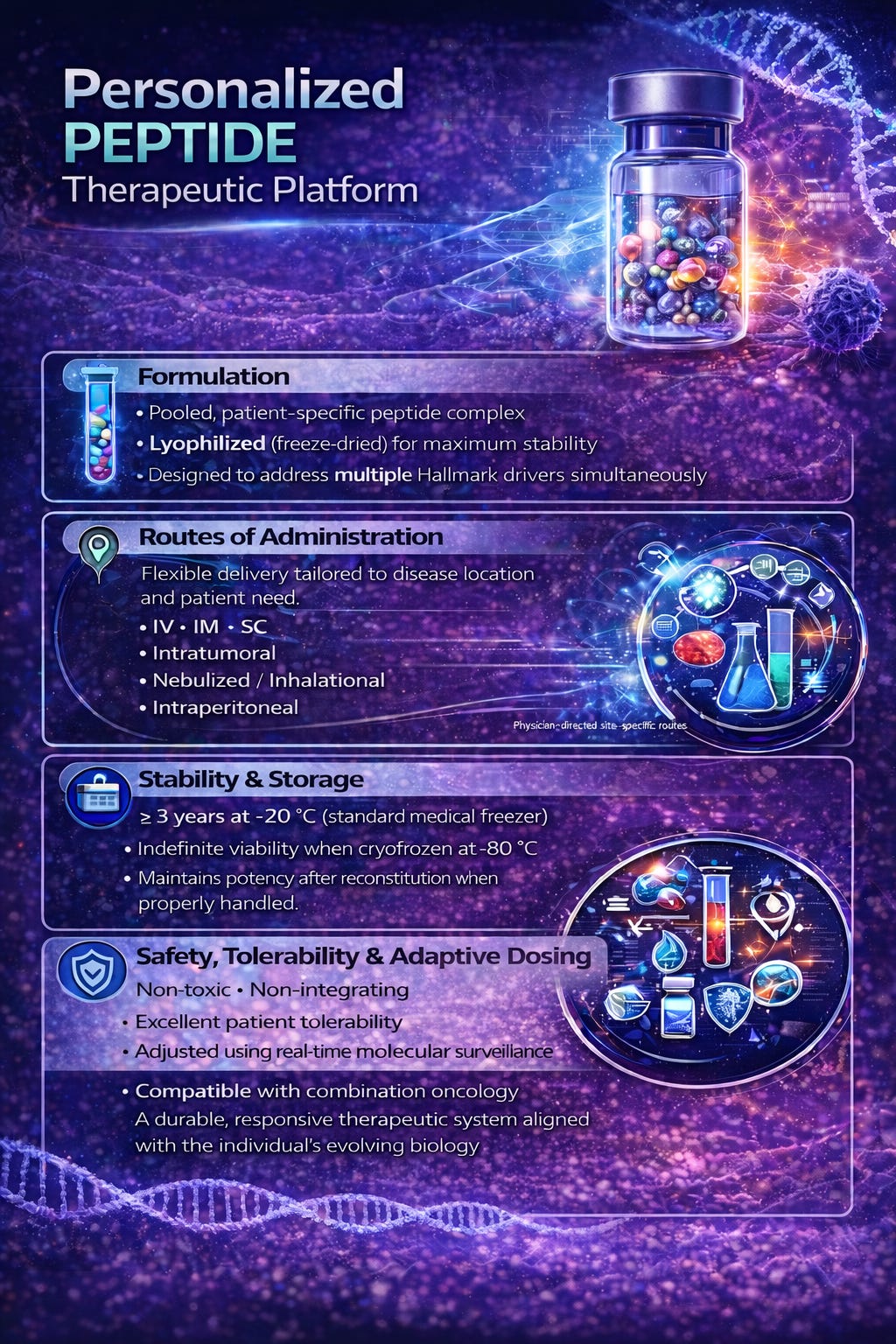
Neo7 personalized peptides are produced as a lyophilized (freeze-dried) pooled complex, enabling exceptional stability, flexibility, and clinical utility. This formulation supports multiple routes of administration, allowing therapy to be matched precisely to disease location, burden, and patient tolerance, including:
Intravenous (IV)
Intramuscular (IM)
Subcutaneous (SC)
Intratumoral
Nebulized / inhalational
Intraperitoneal
Other site-specific or physician-directed routes
This versatility allows peptides to be deployed systemically or locally, maximizing therapeutic impact while minimizing unnecessary exposure.
Stability, Viability, and Storage
A critical advantage of Neo7 peptide therapeutics is their exceptional stability:
Viable for ≥3 years at −20 °C in a standard medical freezer
Indefinite stability under cryogenic storage
Resistant to degradation when properly reconstituted and handled
This long-term viability enables advanced manufacturing, secure storage, and adaptive reuse as patient needs evolve—without loss of potency.
Safety, Tolerability, and Dose Personalization
Neo7 personalized peptides are excellently tolerated, reflecting their non-toxic, non-integrating biological design. Unlike cytotoxic agents or gene-transfer platforms, these peptides are engineered to modulate signaling rather than damage tissue.
Each therapeutic dose is:
Individually tailored to the patient’s molecular profile
Adaptively adjusted based on real-time clinical response and surveillance data
Designed to preserve immune competence and tissue integrity
This dosing flexibility allows clinicians to escalate, taper, or modify therapy as biology dictates—maintaining efficacy while avoiding cumulative toxicity.
A Therapeutic Designed for Long-Term Stewardship
Together, pooled personalization, flexible administration, long-term stability, and adaptive dosing make Neo7 peptide therapeutics uniquely suited for chronic cancer control, combination therapy, and long-term survivorship. This is not a one-time intervention—it is a durable, responsive therapeutic system aligned with the individual's evolving biology.